




How To Tell If Your Ruby Is Glass Filled Composite

Two rubies can look identical and be worth wildly different money. Often the reason is glass. Here is how to check yourself, in about two minutes, with a loupe you can buy for twenty dollars.
What glass filling actually is
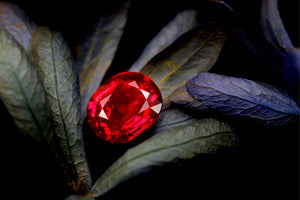
A lead glass filled ruby is real corundum. It is not synthetic and it is not fake. But it started as material almost nobody could sell.
- The rough is heavily fractured, so broken up that it is close to worthless as a gemstone.
- It is heated with a lead oxide glass, which melts and flows into every fracture that reaches the surface.
- Lead glass bends light at close to the same rate as ruby. Once the cracks are full of it, they stop reflecting and effectively disappear.
- What comes out looks clean and red for a fraction of the price of an untreated or simply heated stone.
The treatment has been in the market since roughly 2004 and is now common in inexpensive ruby jewelry worldwide.

This is not the same as heat treatment. Most rubies and sapphires on the market are heated, and heat is permanent, centuries old, and accepted throughout the trade. Glass filling adds a foreign material to the stone and it is not permanent. Heat is fine. Glass is a different conversation.
How to spot it yourself
Use a 10x loupe and a bright, focused light. Hold the stone so the light enters from the side rather than straight on, and rotate it slowly. Work through these three in order.
01Gas bubbles
This is the clearest tell and the easiest to see. As the molten glass fills the fractures, air gets trapped inside it. Under magnification you see small round or flattened bubbles sitting inside the stone.
- Rubies do not grow gas bubbles. Glass does.
- They often sit in lines or clusters, following the path of a healed fracture.
- If you find them, you are done. No further test is needed.
02The flash effect
Keep tilting the stone and watch for a flash of colour that appears and vanishes at specific angles, usually blue or violet one way and orange or yellow the other.
- The flash comes from the small difference in how glass and ruby bend light. You are seeing the boundary between the two.
- It shows only at certain angles, so slow rotation matters more than strong magnification.
- Natural inclusions in a ruby do not produce this effect.
GIA has published magnified images of the flash effect in filled corundum, which are worth looking at before you try this yourself. Their research library is at gia.edu/gems-gemology.
03Surface texture
Tilt the stone under reflected light and look across the facets rather than into them. Glass polishes differently from corundum, so filled areas can read as slightly duller or lower than the surrounding surface. Heavily treated stones sometimes show a crazed, crackled texture where the filler meets air.
Why it matters after you buy
The filler is not permanent, which creates real problems that a normal ruby never has.
- Heat. A jeweler's torch during a resize, a retip, or a repair can damage or destroy the glass. The fractures come back and the stone can look worse than before it was treated.
- Acid. Standard pickling solution used in jewelry workshops will attack it. So will household cleaners, and even lemon juice given enough contact.
- Ultrasonic and steam cleaning. Both are routine at most jewelers and both can harm a filled stone.
- Value. A filled ruby is priced as a different product entirely, not as a discounted ruby.
If you own one, none of this means you should stop wearing it. It means you tell any jeweler what it is before they touch it.
What to ask a seller
Ask this directly, in writing, before you buy:
- "Is this stone lead glass filled or composite?"
- "What treatments has it had, and are they disclosed on a lab report?"
- "Which laboratory issued the report, and can I see it?"
A straight answer sounds like a specific treatment named plainly. Vague answers, "all rubies are treated" or "it's completely natural" without a report, are the signal to walk away. Under the US Federal Trade Commission's Jewelry Guides, a composite of ruby and glass cannot be sold simply as "ruby" without disclosure.
When to send it to a lab
A loupe catches most filled stones. It will not catch everything, and it cannot confirm origin or separate some synthetics. For any stone where the answer changes what you would pay, a report from a major laboratory is the only definitive answer. All of these identify and disclose glass filling:
- GIA, Gemological Institute of America
- AGL, American Gemological Laboratories
- GRS, GemResearch Swisslab
- SSEF, Swiss Gemmological Institute
- Gübelin Gem Lab
Watch me do it
Same test, thirty seconds, on two stones side by side.
Got a ruby you're unsure about?
Send me a photo on WhatsApp and I'll take a look. A clear shot in daylight is usually enough for me to tell you whether it's worth putting under a loupe properly.
Written by Josef Gad, co-founder of Assay Jewelers. We buy, restore and sell rare gemstones and antique jewelry from New York, Miami and Hong Kong.